
Over the past few months I’ve spoken with a number of founders preparing to raise capital. One wanted feedback on a pitch deck, another asked if I knew investors worth talking to, and a third wondered why they weren’t getting more meetings.
At first those sounded like different problems. The more conversations I had, the more they seemed to point to the same underlying issue, and I don’t think it was fundraising at all.
I think founders often treat fundraising as a communication problem, while investors experience it as an uncertainty problem. Investors don’t need the risk to disappear; they need enough evidence to believe that the remaining risk is worth taking. That is a very different question from “How do we tell a better story?”
Realising that has gradually changed how I think about fundraising. Much of the advice founders receive focuses on the fundraising event itself: the pitch, the deck, the meetings and the narrative. Those things matter, but they don’t create confidence on their own. Confidence grows out of the business itself by systematically reducing the uncertainties that matter most.
Instead of asking how to convince investors, I think founders should ask themselves three questions:
- What assumptions does this business depend on?
- Which of those assumptions have we actually tested?
- What evidence would materially strengthen the company?
Almost every time those questions expose something fundamental. They reveal uncertainty about why customers buy, how large the opportunity really is, what problem the product actually solves, or whether the greatest risk is commercial rather than technical. Discovering those gaps is not a setback. It is the work that makes the company stronger and the investment case more credible.
Over time, I’ve started thinking about this as Capital Readiness: the operating discipline of turning investment uncertainty into evidence.
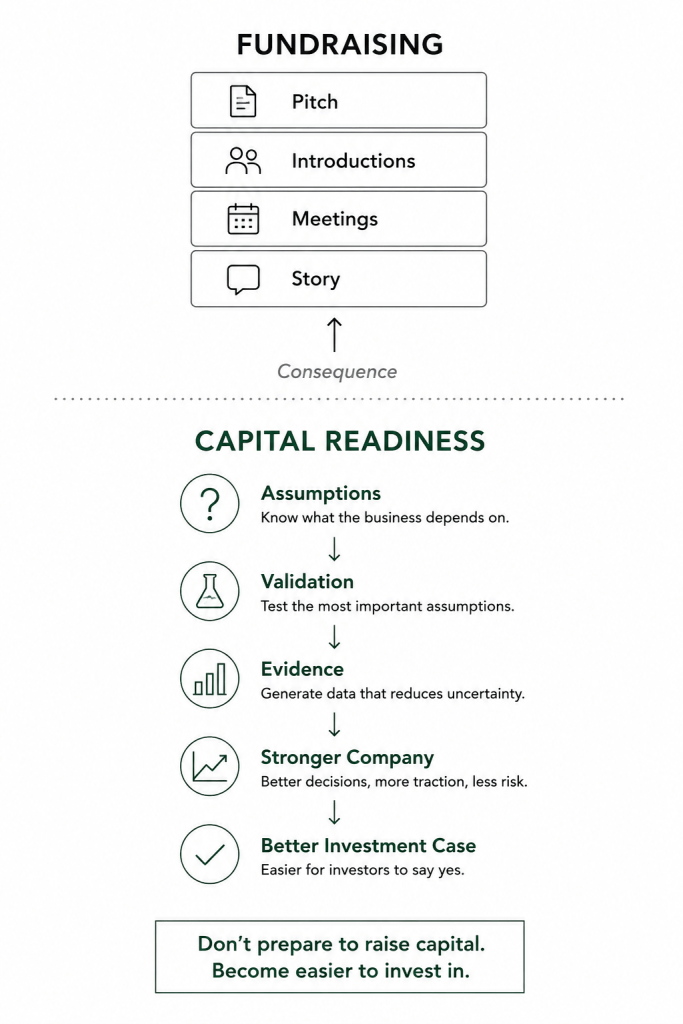
The real objective is to build a company that increasingly makes investment sense. When that happens, fundraising changes almost as a consequence. Investors still ask difficult questions and uncertainty never disappears completely, but there is less and less left to explain because the business itself provides the answers.
I’ve come to believe that this is what founders should optimise for.
Not becoming better at pitching, but becoming steadily easier to believe in.

 Jörn Green