
Operator Note
Part of the Green Bear Operating Manual: field observations from inside technology companies where growth, complexity, and uncertainty begin to affect decisions.
For almost ten years I believed that scaling was primarily a coordination problem.
The idea seemed obvious enough that I never felt much need to challenge it. As organisations grow, communication becomes harder. More people create more dependencies. More teams create more interfaces. More managers appear because somebody eventually has to keep track of what everybody else is doing.
I was so convinced by this explanation that I eventually built a model around it.
The model was simple. On one axis sat the number of people in the organisation. On the other sat productive output. My assumption was that every additional hire created coordination overhead, meaning that the contribution of each new person would gradually decline as the organisation grew larger. The curve looked convincing enough that I carried it around in my head for years.
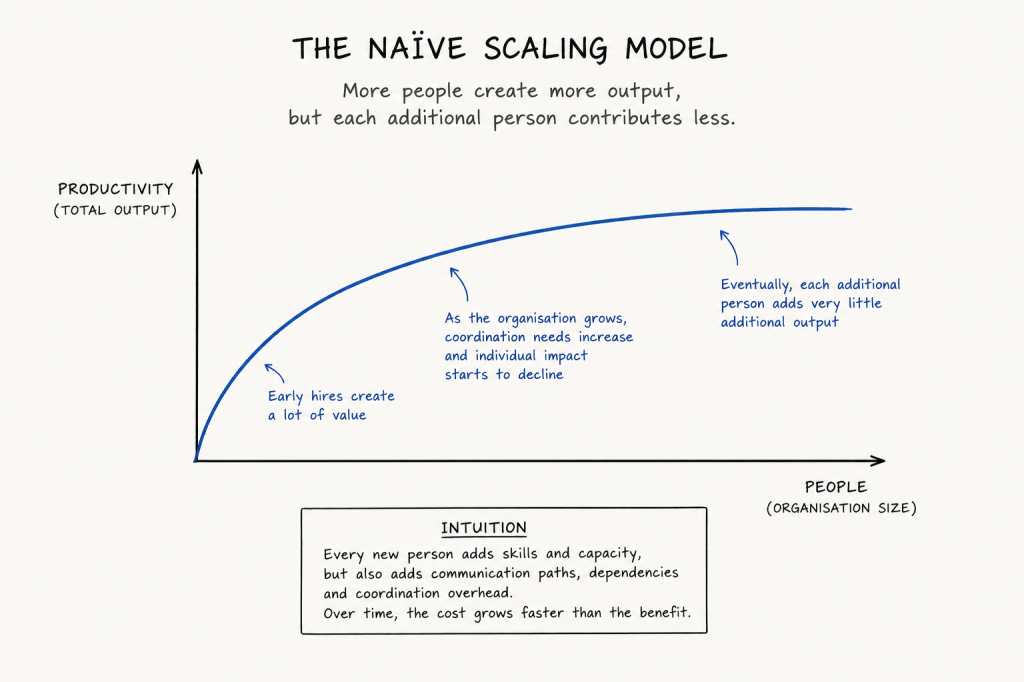
At the time I worked for Sony and much of what I observed appeared to support it. Teams were spread across countries, functions and reporting structures. As the organisation expanded, increasing amounts of time seemed to disappear into meetings, planning sessions, reporting forums and alignment activities. Nobody was doing anything wrong. The organisation was simply becoming more complicated.
At least that was how I understood it.
The first cracks appeared slowly.
Later, at Ubisoft, I found myself responsible for an organisation that grew from around 40 people to more than 200. If my model was correct, the coordination challenges should have become overwhelming. In many ways they did. There were more stakeholders, more dependencies and more competing priorities than I had ever dealt with before.
Yet something about the experience bothered me.
Some decisions took forever while others happened surprisingly quickly.
Some discussions became hopelessly tangled despite involving only a handful of people. At the same time, entire groups could occasionally align around a difficult decision with remarkably little friction.
The behaviour was inconsistent. I could explain isolated examples. What I could not explain was the pattern.
The contradiction became even harder to ignore later at Play’n GO. By then I was responsible for parts of an organisation of more than 300 people spread across development, mathematics, art, analytics and operations. According to my model, this should have been a textbook example of coordination becoming the limiting factor.
Instead I found myself watching situations that made less and less sense.
Teams that should have struggled sometimes moved quickly. Teams that should have agreed sometimes became stuck.
People who were intelligent, experienced and acting in good faith could spend weeks debating problems without getting noticeably closer to resolution.
For a while I assumed I simply had not refined the model enough.
Perhaps there were missing variables, or organisational culture mattered more than I thought orleadership quality changed the curve.
Looking back, I suspect I was searching for ways to save an explanation that had become emotionally comfortable as good model does more than explain reality. It creates the feeling that reality is understandable.
Giving that up is surprisingly difficult.
Around that time I found myself thinking about an old meeting that had happened years earlier. The meeting itself was entirely forgettable. I cannot remember the feature being discussed and I doubt anybody else involved remembers it either. What stayed with me was the frustration I felt walking out of the room.
A salesperson wanted a customer request prioritised, the engineering lead pushed back and product was trying to navigate between them. The discussion consumed the better part of an hour and seemed to produce more disagreement than progress.
At the time I left convinced that I had just witnessed organisational politics. It looked like one of those situations where departments become protective of their own interests and stop thinking about the company as a whole.
Years later I started wondering whether that interpretation had been unfair. The salesperson had spent weeks listening to customers, the engineering lead understood technical consequences that the customer never saw and product was balancing commercial opportunities against practical realities.
Each person was describing something real.
The problem was that none of them were describing the same thing and that observation followed me around for years.
I encountered versions of it in different companies, different industries and different leadership teams. The names changed and the products changed, but the underlying dynamic felt strangely familiar. Intelligent people were arriving at different conclusions because they were navigating from different maps.
Once I started looking at organisations through that lens, my old model began to feel incomplete. Coordination was still part of the picture, but it increasingly looked like a symptom rather than a cause.
After all, coordination problems are easy to see.
You can count meetings, measure decision cycles and map reporting structures. Shared understanding is much harder to measure.
Nobody walks into a quarterly review and reports that the organisation currently contains seven competing interpretations of reality. Yet the more organisations I worked with, the more important that invisible factor seemed to become.
When companies were small, people tended to experience the same events. Engineers heard customer complaints directly. Product managers understood operational constraints. Commercial teams had some visibility into technical realities. Nobody called this alignment because there was no need to. Shared understanding emerged naturally from proximity.
Growth changed that. As organisations expanded, people became specialists. Expertise deepened. Teams formed around functions. Layers appeared. None of these developments were inherently problematic. Most were necessary. The unintended consequence was that people gradually stopped seeing the same landscape.
The engineer understood one part, sales understood another, ops understood a third and finance saw risks invisible to everybody else.
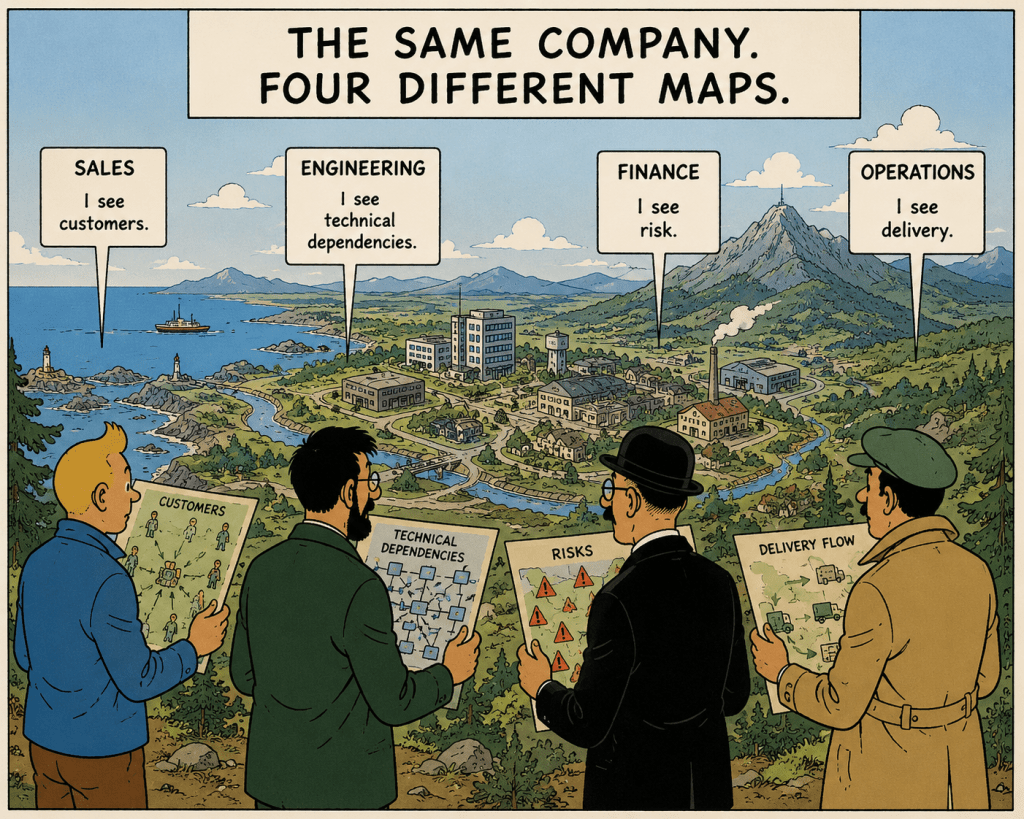
Every perspective contained useful information. None contained the whole picture.
The old story about the blind men and the elephant survives because it captures something fundamental about how humans experience complexity. Each person is touching something real, yet none of them can fully understand what they are touching because they only have access to a fraction of it.
Increasingly, I suspect organisations work in much the same way.
I am still not entirely convinced that I have found the right explanation. Experience has made me suspicious of theories that seem too neat. The world has a habit of producing counterexamples at precisely the moment we become convinced that we understand it.
What I do know is that I think differently about leadership than I once did. Earlier in my career I admired leaders who seemed capable of making the right decisions.
Today I find myself admiring leaders who help other people understand the same situation. They spend less time acting as decision makers and more time acting as translators. They connect perspectives, provide context and help different parts of the organisation understand why intelligent people can arrive at different conclusions.
For years I believed scaling was primarily about coordination.
These days I wonder whether coordination is simply where the damage becomes visible.
The deeper challenge may be helping hundreds of people maintain a shared understanding of reality after the organisation becomes too large for everyone to participate in the same conversation.
I don’t pretend to have solved this problem. In many ways this article exists because I am still trying to understand it.
What I do know is that I have spent the last twenty-five years working inside organisations that were growing, changing, struggling, succeeding and occasionally confusing the hell out of everyone involved.
If you recognise your own organisation somewhere in this story, feel free to reach out. https://calendly.com/mansen66/jorn-1on1
If your organisation is growing, but reality feels harder to see, the issue may not be coordination.
It may be that different teams are operating from different maps of the same company. Start with The Next Bet, explore the Case Files, or book a working session.


Lämna ett svar