
Operator Note
Part of the Green Bear Operating Manual: field observations from inside technology companies where growth, complexity, and uncertainty begin to affect decisions.
We were sitting in a room, reviewing a product demonstration that, by most reasonable standards, should have led to commercial traction. The system worked as intended. The underlying logic held together. The reactions in the room suggested genuine recognition of value.
For a brief moment, the conclusion seemed straightforward.
This should sell.
And yet the question remained. Why is nobody buying this?
The discussion that followed was neither chaotic nor uninformed. On the contrary, it was structured, deliberate, and grounded in familiar lines of reasoning. Marketing was examined, positioning reconsidered, pricing questioned, and additional use cases proposed. Each suggestion was plausible. Each could be justified.
What emerged was not confusion, but multiplicity.
Several viable directions, none sufficiently dominant to compel commitment.
The meeting progressed. The situation did not.
Situations of this kind are often described as failures of prioritisation or execution. While this is not entirely inaccurate, it is incomplete. What appears at the surface as a failure to prioritise is more often a failure to establish direction under conditions of abundance.
This distinction reflects a deeper misalignment between the problems organisations face and the functions they rely on to address them.
To understand this, it is useful to distinguish between four functions that are frequently conflated in practice: management, advisory, contracted execution, and operation.
These are not titles, nor hierarchical levels. They are distinct modes of engaging with organisational problems.
Management as a Function of Stability
The managerial function emerged as a response to industrial complexity. As Alfred Chandler described, large organisations required structured coordination to replace the spontaneous ordering of markets. Management became the mechanism through which strategy was translated into organised execution.
Peter Drucker extended this logic into knowledge work, positioning managers as responsible for setting objectives and enabling productivity across distributed expertise. Henry Mintzberg later observed that managerial work consists largely of coordination, communication, and maintaining coherence across fragmented activities.
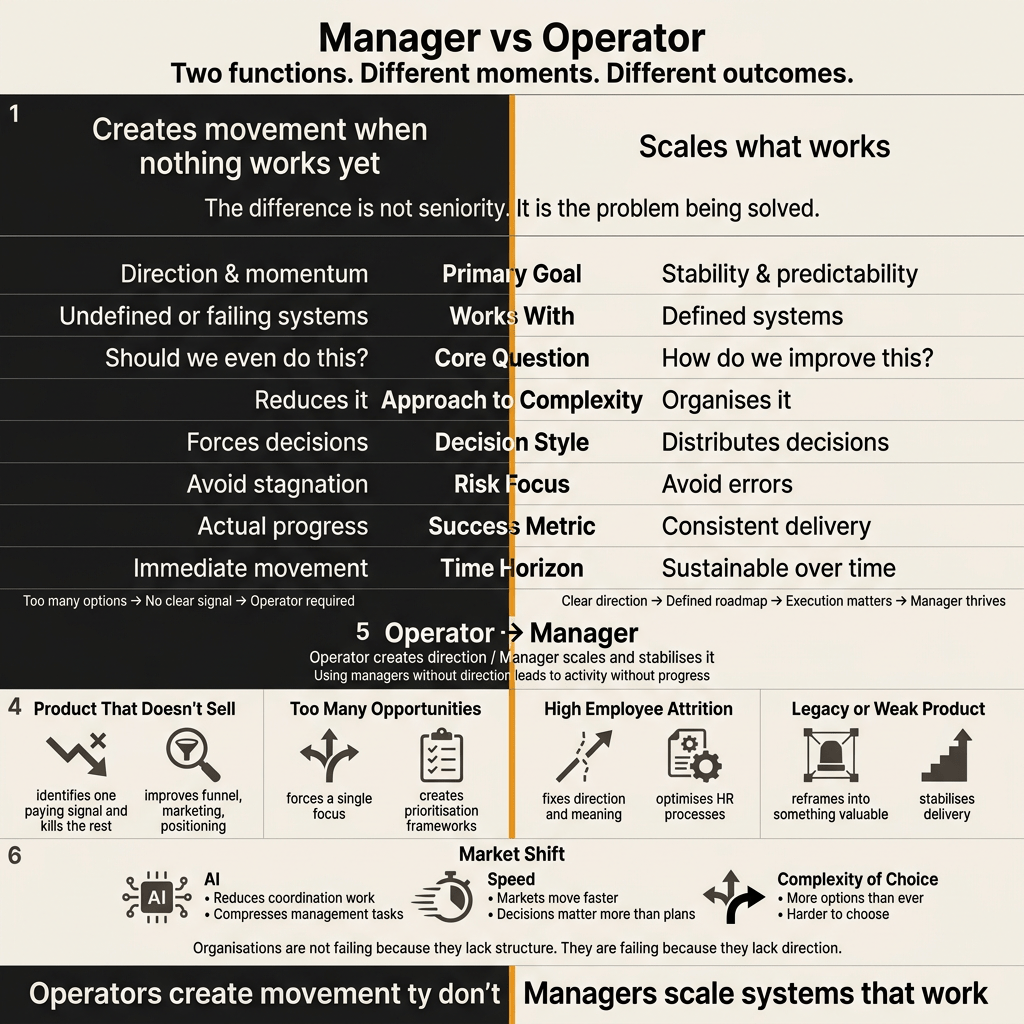
Across these perspectives, a consistent pattern emerges. Management is fundamentally concerned with stability. It ensures that defined objectives are executed reliably. It creates predictability, distributes responsibility, and sustains performance over time.
This function remains indispensable, but it presupposes that direction has already been established.
Advisory as a Function of Perspective
Advisory work operates at a different level. The advisor contributes analysis, framing, and external perspective. This function is particularly valuable when organisations need to reinterpret their situation, challenge assumptions, or explore alternative paths.
However, advisory work does not typically carry ownership of outcomes. Its value lies in informing decisions rather than making them.
It expands the space of possible interpretations, but it does not in itself resolve ambiguity.
Contracted Execution as a Function of Capacity
In many European contexts, the term “consultant” refers not to advisory work but to contracted execution. These individuals are brought in to perform defined tasks, often embedded within teams, contributing directly to delivery while remaining external to the organisation.
This function addresses capacity. It allows organisations to scale execution without increasing permanent headcount.
Like advisory work, however, it does not inherently carry ownership of direction. The contractor executes what has been defined, but does not define it.
Operation as a Function of Direction
The operational function becomes visible when neither execution nor analysis is sufficient to resolve a situation.
The operator engages with the problem of direction itself.
This involves reducing optionality rather than organising it, committing to a course of action in the absence of complete information, and aligning execution around that commitment. Where management sustains a system, and advisory interprets it, the operator alters its trajectory.
The distinction is not hierarchical. It is functional.
Management scales what works.
Advisory explains what might work.
Contracted execution delivers what is defined.
The operator determines what will be pursued.
A Comparative View
| Function | Primary Concern | Mode of Engagement | Relationship to Direction | Outcome |
|---|---|---|---|---|
| Management | Stability and execution | Coordination and structure | Executes defined direction | Consistent delivery |
| Advisory | Understanding and framing | Analysis and recommendation | Informs direction | Conceptual clarity |
| Contracted Execution | Capacity and delivery | Task-based contribution | Follows direction | Increased throughput |
| Operation | Direction and movement | Selection and commitment | Defines direction | Tangible progress |
Revisiting the Initial Scenario
Returning to the situation described at the outset, the roles become easier to distinguish.
An advisor would analyse the lack of traction, offering hypotheses around positioning, segmentation, or pricing.
A manager would structure the next steps, assign responsibilities, and ensure follow-through across the organisation.
A contractor might be engaged to execute specific initiatives, such as refining the product, running campaigns, or implementing tools.
Each function contributes. None resolves the core issue.
The difficulty lies in the absence of commitment to a single direction. Multiple viable paths remain open, and the organisation, acting rationally, hesitates to exclude any of them.
The operator intervenes differently. Rather than expanding or structuring the set of possibilities, the operator reduces it. A specific signal, often grounded in observable behaviour, is selected as the basis for direction. Other paths, however promising, are deprioritised or eliminated.
This does not guarantee success, but it creates the conditions under which success or failure can be meaningfully determined.
Perception, Risk, and Organisational Context
The role of the operator is not only defined by function, but also by how it is perceived within a given organisational context.
Because the operator challenges existing priorities, operates across formal boundaries, and commits to decisions under uncertainty, the role introduces a form of directional risk. It requires autonomy, and it does not fully conform to established hierarchies.
In environments that emphasise predictability, role clarity, and procedural alignment, this can be perceived as a liability. The operator may be seen as insufficiently aligned with structure, or as disruptive to cohesion.
In such contexts, organisations tend to favour functions that reinforce stability, whether through management or clearly defined external contributions.
In contrast, environments characterised by higher competitive pressure, shorter feedback cycles, and greater tolerance for uncertainty tend to interpret the same characteristics differently. The ability to act without full consensus, to reduce complexity through decisive choice, and to move across boundaries becomes an asset.
This divergence has practical consequences. Organisations that integrate operational functions effectively often demonstrate a greater capacity to adapt, resolve internal bottlenecks, and convert potential into measurable outcomes. Where such roles are constrained, similar situations may persist longer, supported by ongoing activity without corresponding progress.
Why This Distinction Matters Now
Several broader developments make this distinction increasingly relevant.
Technological advances, particularly in artificial intelligence, are reducing the effort required for coordination, analysis, and information processing. This shifts the value of human contribution toward judgement and decision-making.
Economic conditions in many sectors favour speed over optimisation. The ability to move from hypothesis to validation becomes more critical than refining existing systems.
Organisationally, many firms continue to operate with structures optimised for stability, even as their challenges require directional change.
These factors do not diminish the importance of management, advisory, or execution. They highlight the limitations of relying on them in isolation when the primary challenge is to establish direction.
Conclusion
ContempoContemporary organisations often describe their challenges in terms of agility, speed, or focus. While these concepts capture aspects of what is being experienced, they tend to describe symptoms rather than causes.
At a more fundamental level, the challenge concerns the capacity to define and commit to direction in environments characterised by abundance rather than scarcity. The difficulty is no longer primarily how to execute a plan, nor how to analyse a situation, but how to select a course of action when several remain plausible and none are certain.
Within this context, the distinction between organisational functions becomes more consequential.
Management provides the means to execute and sustain.
Advisory provides the means to interpret and reframe.
Contracted execution provides the means to extend capacity.
The operational function provides the means to choose.
These functions are complementary, but they are not interchangeable. Each addresses a different class of problem, and their effectiveness depends on being applied at the appropriate moment.
When direction is clear, management becomes decisive. When understanding is incomplete, advisory work becomes valuable. When capacity is constrained, external execution can accelerate delivery. However, when direction itself is unresolved, none of these functions are sufficient on their own.
It is under these conditions that the absence of operational ownership becomes visible.
Organisations may continue to generate activity, to analyse, to coordinate, and to deliver within defined frames. Yet without a committed direction, this activity risks remaining internally coherent while externally ineffective. The appearance of progress is maintained, but its substance becomes difficult to establish.
The practical implication is not that one function should replace another, but that organisations must develop the ability to recognise which problem they are facing.
In situations defined by execution, stability is required.
In situations defined by ambiguity, perspective is required.
In situations defined by uncertainty of direction, commitment is required.
The operator emerges in response to the latter.
Not as a superior role, but as a necessary one when the central challenge is no longer how to proceed, but what to proceed with.
References
- Chandler, A. D. (1977). The Visible Hand: The Managerial Revolution in American Business
- Drucker, P. F. (1974). Management: Tasks, Responsibilities, Practices
- Mintzberg, H. (1973). The Nature of Managerial Work
- McKinsey & Company. Research on middle management and organisational performance
#Leadership #Management #Strategy #Operations #Execution #DecisionMaking #BusinessTransformation #FutureOfWork #AIinBusiness #Scaling
If this sounds familiar, the issue may not be execution.
It may be that the next important decision has not been made with enough evidence to hold. Start with The Next Bet, explore the Case Files, or book a working session from the homepage.


Lämna ett svar